At the intersection of art and cycling stands ArtNouvélo, a project born from nostalgia, motion, and an enduring search for meaning. Behind it is co-founder and creative mind Bruno Vanobberghen, whose lifelong relationship with both brushes and pedals gradually converged into a singular artistic direction.
ArtNouvélo is not merely about depicting cycling; it is about translating the emotional and human essence of the sport onto canvas.
Bruno’s connection with the bicycle begins southwest of Brussels, where he spent countless hours of his childhood in the rolling landscapes of the Pajottenland region. Weekly visits to his grandparents left an indelible mark. His grandfather, a gentle and patient man, embodied a way of life rooted in simplicity and attentiveness. Together they cycled through fields and hills, tackling local climbs on heavy steel bikes with limited gears, rewarded afterwards by homegrown food and homemade Belgian cuisine. These rides were not about performance or prestige. Cyclists were not stars; they were postmen, factory workers, everyday people who became heroes for a day during local races around the church square. It was here that the first seed of Bruno’s love for cycling was planted.
"My grandfather always told me : "If a painting does not work today, it tells you that it wants you to wait until tomorrow." This philosophy would later resonate deeply with Bruno’s own outlook on both art and sport: knowing when to push, and when to slow down without guilt."
Art entered his life just as naturally. His grandfather painted in his spare time, using simple materials and an intuitive approach. Technique was secondary to feeling. Colours and moods mattered more than precision, and creativity was never forced. If a painting did not work one day, it could wait until tomorrow. This philosophy would later resonate deeply with Bruno’s own outlook on both art and sport: knowing when to push, and when to slow down without guilt.

While art and cycling were present from an early age, their true synergy emerged much later.
Bruno’s deeper passion for cycling ignited in 1997 during a school trip around Corsica. Riding day after day through demanding terrain revealed cycling as something meditative, almost therapeutic. The physical fatigue faded in comparison to the sense of accomplishment and inner calm it provided. From that moment on, the desire to ride — much like the urge to create — became a recurring, almost necessary impulse. Brussels’ green lung, the “Zonienwoud” forest, with its majestic beech trees and fast trails, became the backdrop for Bruno’s exploits on a stripped-down city bike, making it look like a mountain bike with smaller tyres. Call it a “city gravel”. A second-hand alloy road bike with a thin aero frame marked his first encounter with “real” road cycling: six gears in the back, a 52x42 up front, a manual derailleur on the frame, first clip-in pedals, and a full lycra outfit from top to toe. A new world opened.
That race bike, in first instance, meant freedom again. It allowed him to connect, in a sporting way, his home in Brussels with the houses of his grandparents and friends who all lived further outside the capital.
"The ascent of the Provençal giantmarked a symbolic bridge between youth and adulthood. It was a time of change: leaving home, finishing studies, and stepping into independence. It would ultimately also lead to ArtNouvélo, although Andreas and I at that moment were of course totally unaware. "
A pivotal chapter followed in 2003 with a spontaneous post‑university trip to Mont Ventoux. Together with Andreas De Boer, Bruno travelled south by train with bikes wrapped in plastic bags, chasing both legend and transition. The ascent of the Provençal giant marked a symbolic bridge between youth and adulthood. It was a time of change: leaving home, finishing studies, and stepping into independence. The climb itself was brutal and imperfect, undertaken with inadequate gear and youthful confidence, but the experience was transformative. Long conversations about life unfolded against the backdrop of vast landscapes,
quiet towns, and the sense of being temporarily unstoppable.
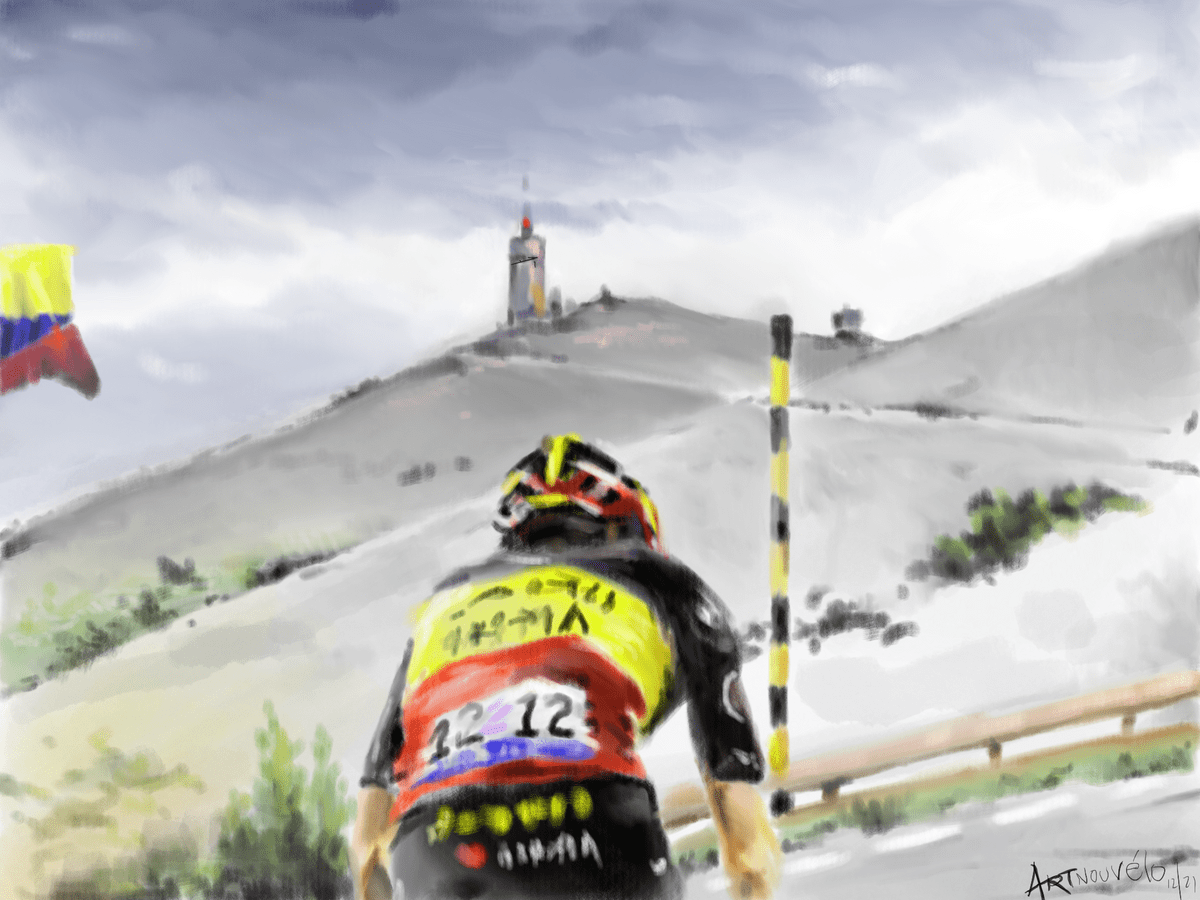
In the course of time, these experiences began to crystallise into a clearer artistic direction. Before ArtNouvélo, Bruno’s work was stylistically diffuse — rich in colour and detail yet searching for coherence. Cycling became the anchor he needed, sometime around 2019. Through cycling-related art posts, a new audience and vibe came around. Andreas entered the stage again, after almost 15 years of parallel lives. They literally picked up conversations again, where they had left off earlier in the French Provence. Their lives had evolved in similar ways, and the two university friends were reflecting on what they would be focusing on next.
Cycling provided Bruno with narrative, symbolism, and a framework onto which personal memories, emotions, and stories could be layered. In Belgium, the sport was once again reaching new heights through the exploits of riders like Wout Van Aert and, shortly thereafter, Remco Evenepoel. Yet it was also a sobering period, marked by the loss of several young, promising cyclists who died while pursuing what they loved most.
Feedback from early viewers confirmed the direction he was taking. His cycling‑focused art resonated deeply, often offering moments of light and recognition during times of personal grief — a reminder that the emotional power of the sport extended far beyond competition alone.
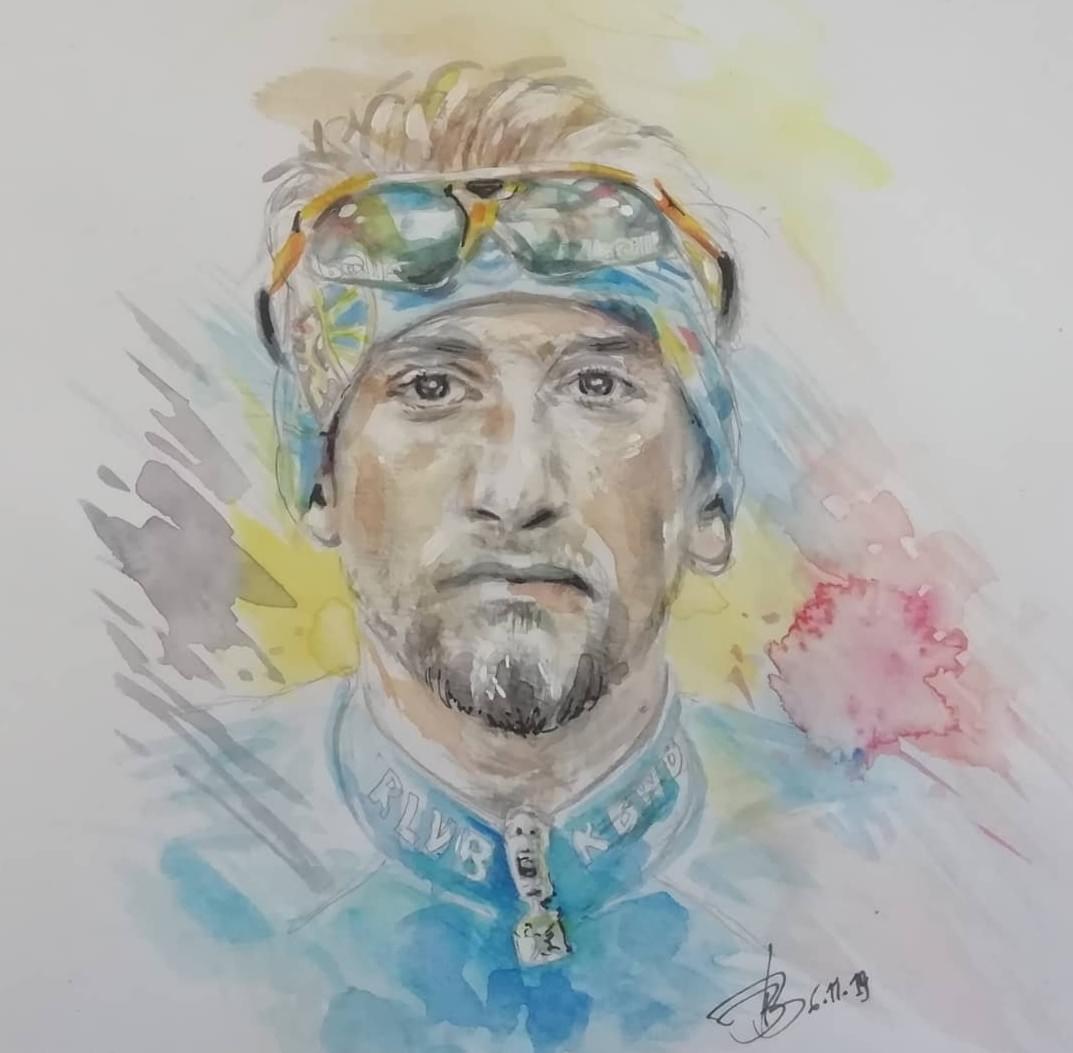
Belgian cycling icon Frank Vandenbroucke occupies a special place in Bruno’s artistic universe.
More than results or victories, it was Vandenbroucke’s audacity, elegance, and tragic trajectory that left a lasting impression. To Bruno, Vandenbroucke embodied the same narrative tension found in great art: brilliance intertwined with fragility. The parallels with Brueghel’s The Fall of Icarus often come to mind. These memories are tinged with nostalgia, shaped by adolescence and the emotional intensity of watching cycling heroes rise and fall. They continue to inform Bruno’s portraits and thematic explorations, even as he acknowledges the complexities and darker chapters of that era.
"Never ever use gridlines. The presence and possibility of failure is essential to creative freedom. Like an attack into the black, hoping to reach the light at the end of the tunnel on time."
Today, ArtNouvélo is a living project — one that evolves with every ride, conversation, and new idea. It is built on collaboration, particularly with Andreas De Boer, and grounded in a shared commitment to returning to the roots of art and cycling. The project acts as a mental compass, a reminder of
identity and intention amidst experimentation and growth.
Bruno’s artistic style blends surrealism, vivid colour, movement, and portraiture. While he once pursued photorealistic perfection, his focus has shifted toward storytelling and emotional impact. Photography, in his view, has claimed realism as a technical skill; traditional art’s role lies elsewhere. Digital tools have become valuable allies, allowing rapid sketching and exploration, especially within the constraints of everyday life, though traditional materials like paper, cardboard, wood and canvas remain close to his heart. One personal rule endures: he never uses gridlines. For him, they impose too much safety, too much certainty. The possibility of failure is essential to creative freedom.
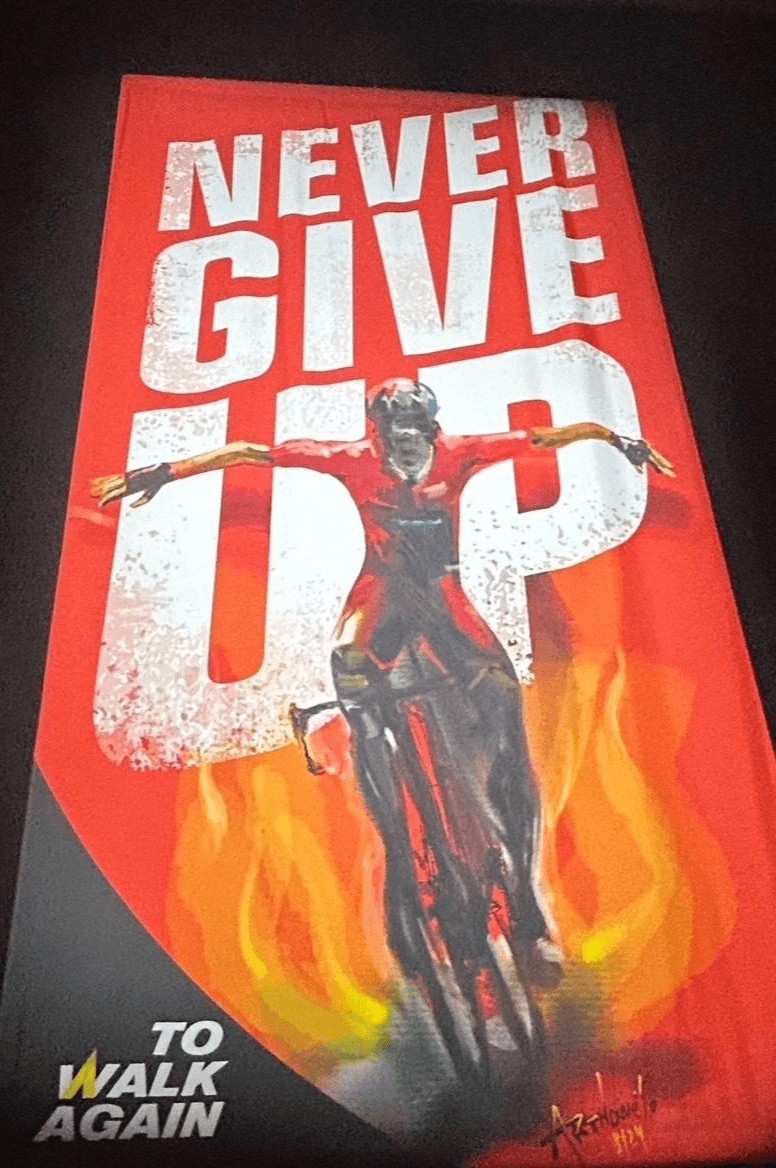
Among ArtNouvélo’s most visible milestones is the collaboration with To Walk Again,where artworks were auctioned for charitable purposes with the support of figures such as Wout Van Aert. Yet Bruno resists measuring success through names or numbers alone. Every genuine interaction with his work carries equal weight, whether it comes from a celebrated athlete or an anonymous viewer.
Disappointments have been rare, though an unrealised collaboration linked to the World Championships in Leuven (Louvain) remains unfinished business. Still, Bruno views it as part of a broader rhythm — much like a bicycle chain that moves backward at one point only to drive the rider forward.
Despite occasional proximity to the professional peloton, Bruno keeps a respectful distance. He values the quiet focus athletes need and prefers letting the artwork speak independently. Art, after all, does not require physical presence of its creator to connect with the spectator. Beauty lies in the eyes of the
beholder.
When it comes to artificial intelligence, Bruno remains cautiously observant. He does not currently use it in his illustrations, nor does he feel compelled to. While acknowledging its potential as a tool, he senses a growing sameness in digital and AI‑generated imagery. His instinct is to slow down, to return to tactile
materials and the deliberate pace of drying paint. Metrics and algorithms may measure progress, but, as he puts it, only the road truly takes you somewhere.
" Art in its essence, like cycling, thrives on simplicity and curiosity. Take only what fits in your pockets, and allow the journey to surprise you with what it returns."
Among the cycling places that continue to inspire him most are the French Alps — Galibier, Izoard, Alpe d’Huez don't need any further introduction — and the region around Trieste, the last Italian coastal town before entering Slovenia and the Istrian Peninsula. Here the Adriatic sea, cliffs, and steep cobbled streets collide on what was once the boarder of Western and Socialist Europe. Homeground nowadays is Munich with its vast network of beautiful countryside roads always offering stunning views on the nearby Aps. These landscapes, along with the stories of ultra‑distance riders and bikepackers, feed his imagination, even if his own riding remains rooted in simplicity: everything he needs carried in his back pockets.
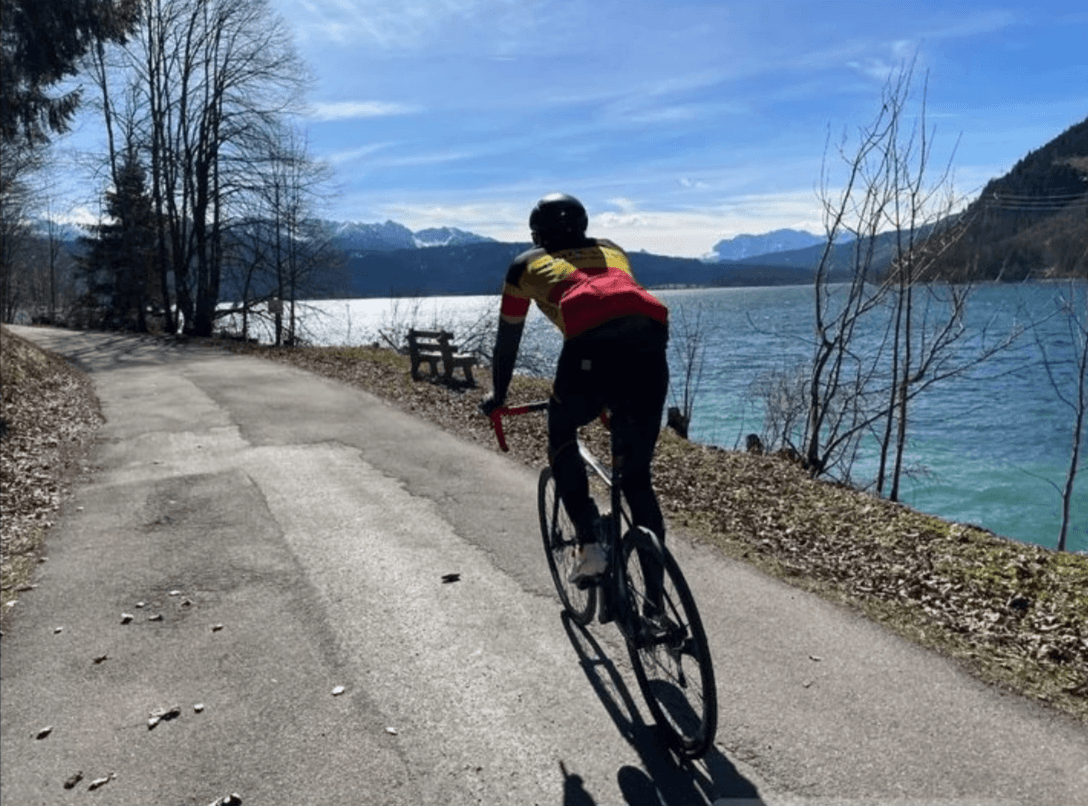
At its core, ArtNouvélo is an invitation to see cycling not just as sport, but as narrative, memory, and art. For Bruno Vanobberghen, the road never truly ends. It simply transforms — into another canvas.
Thank you for having taken the time to read!
